

This research was conducted at Variance. They build AI agents that investigate complex compliance cases. They’re hiring and I recommend working with them!
Executive summary. We constructed a difficult task where agents predict who will be @-mentioned based on historical twitter data. The task requires modeling users’ social graph, interests, and expertise.
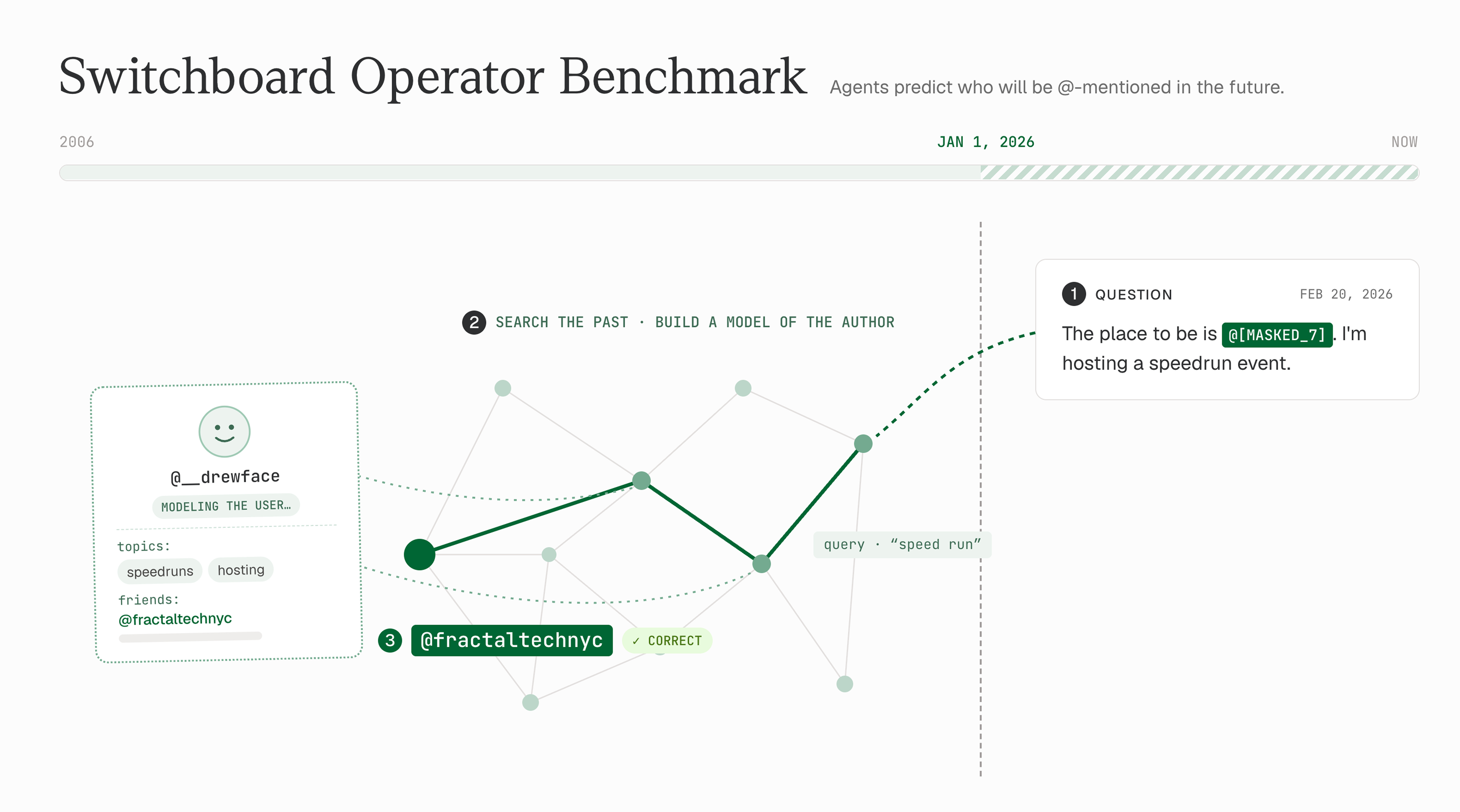
Twitter is the closest thing we have to a global brain. One aspect that makes it exceptional is how it leverages transactive memory.
Transactive memory is a concept from psychology in the 80s that refers to how we map the knowledge and expertise of others. We leverage transactive memory through Twitter every time we tag someone to answer a certain question or tag someone under an opportunity.
Switchboard operator bench
This benchmark is inspired by the role of “switchboard operator” popularized by Visakan Veerasamy on twitter, inspired by Erasmus and Mersenne in 1500s Europe, who corresponded with and made connections between hundreds of intellectuals.
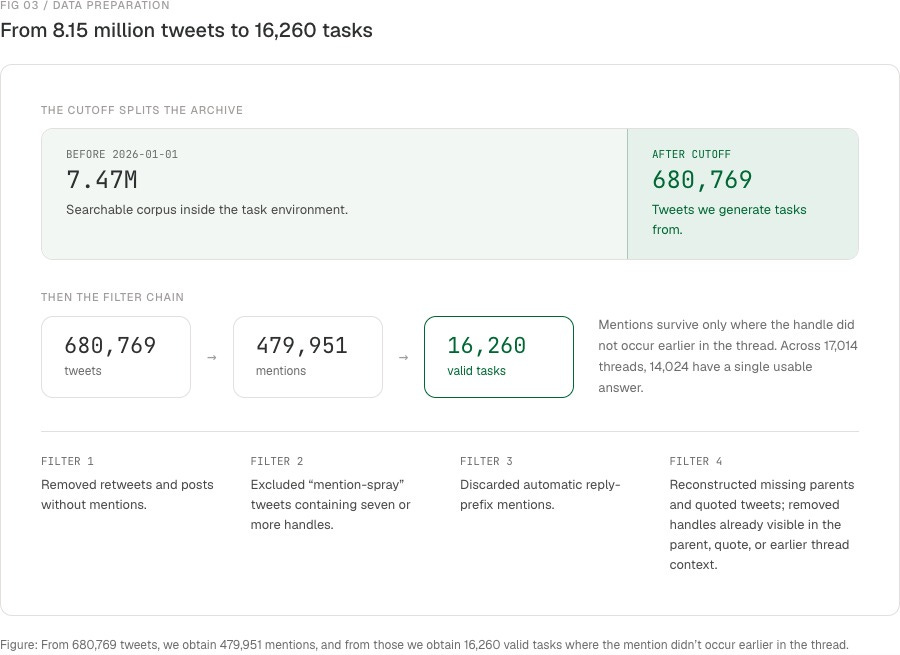
The task idea is simple but challenging:
Take every instance of a username being tagged.
Mask it.
Ask the agent to predict who it refers to. (top-3)
The agent can search a corpus of tweets dated before a cutoff, prior to any of the challenge tweets.
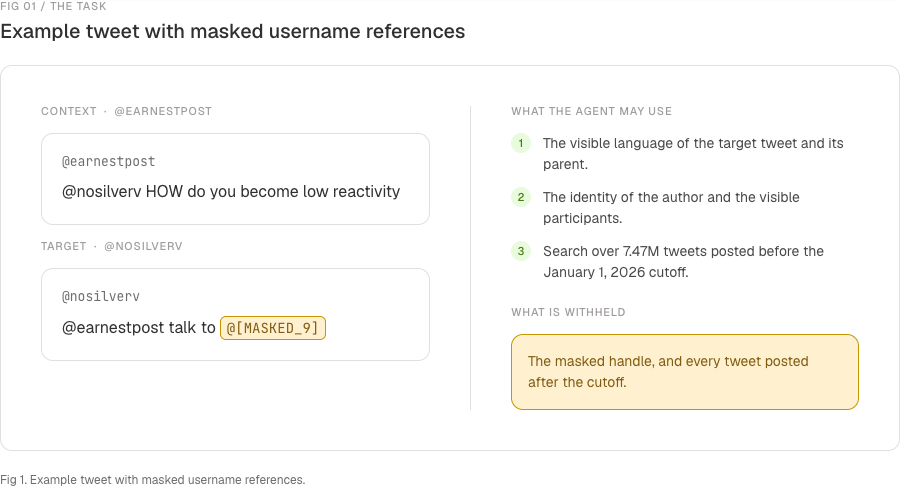
We hypothesize modeling users’ expertise and taste involves searching and querying many posts from participants in a thread and beyond.
Data preparation
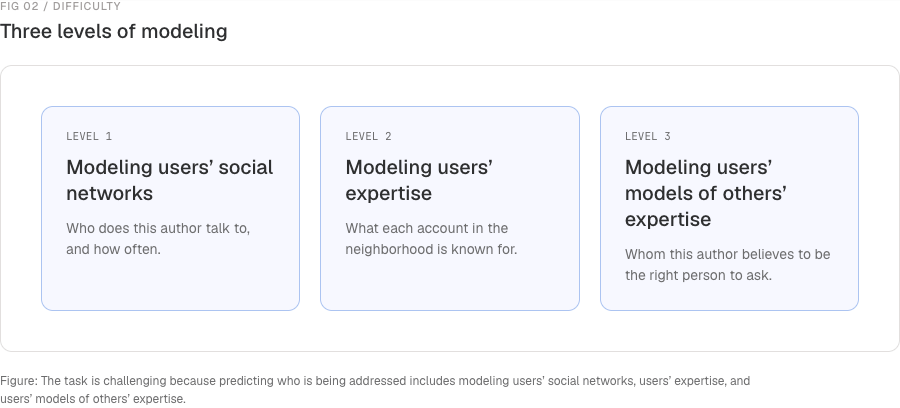
We began with 8.15 million tweets from the Community Archive and fixed a cutoff of January 1, 2026.
We removed retweets and posts without mentions, excluded tweets containing seven or more handles, and discarded automatic prefix mentions from replies.
We reconstructed missing parents and quoted tweets and removed mentions of handles already visible in earlier thread context.
This produced 16,260 candidate (tweet, handle) pairs across 17,014 threads, including 14,024 threads with a single usable answer.
We save the 7.47 million tweets posted before that date as the agent’s in-task searchable corpus.
Mention types
A mention tells us two different things: 1) who the post is oriented toward, and 2) what the mention is doing. We represent these as independent axes.
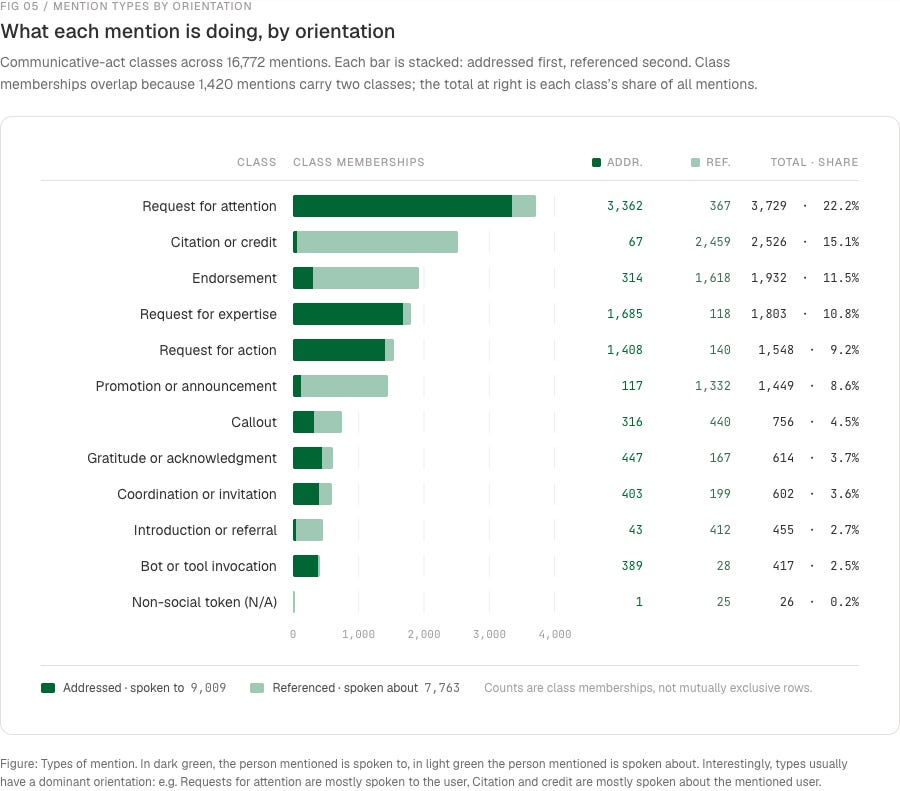
Orientation distinguishes between accounts being addressed in the second person (“hey @bob check this out”) and accounts being referenced in the third person (“@bob’s last essay was great”). Of the 16,772 mentions in our dataset, 9,009 are addressed and 7,763 are referenced.
Communicative-act classes describe the function of the mention: asking for expertise, giving credit, making an introduction, invoking a tool, and so on. We let each mention have up to two unordered classes because these functions sometimes genuinely co-occur. For example, a post may both endorse and promote someone’s work. If no separate communicative function is supported, the mention receives no class. Consequently, the percentages below overlap and do not sum to 100%.
We chose mention types manually from domain knowledge and had an agent go over hundreds of tweets to find classes we may have missed. Below are the communicative-act classes we found.
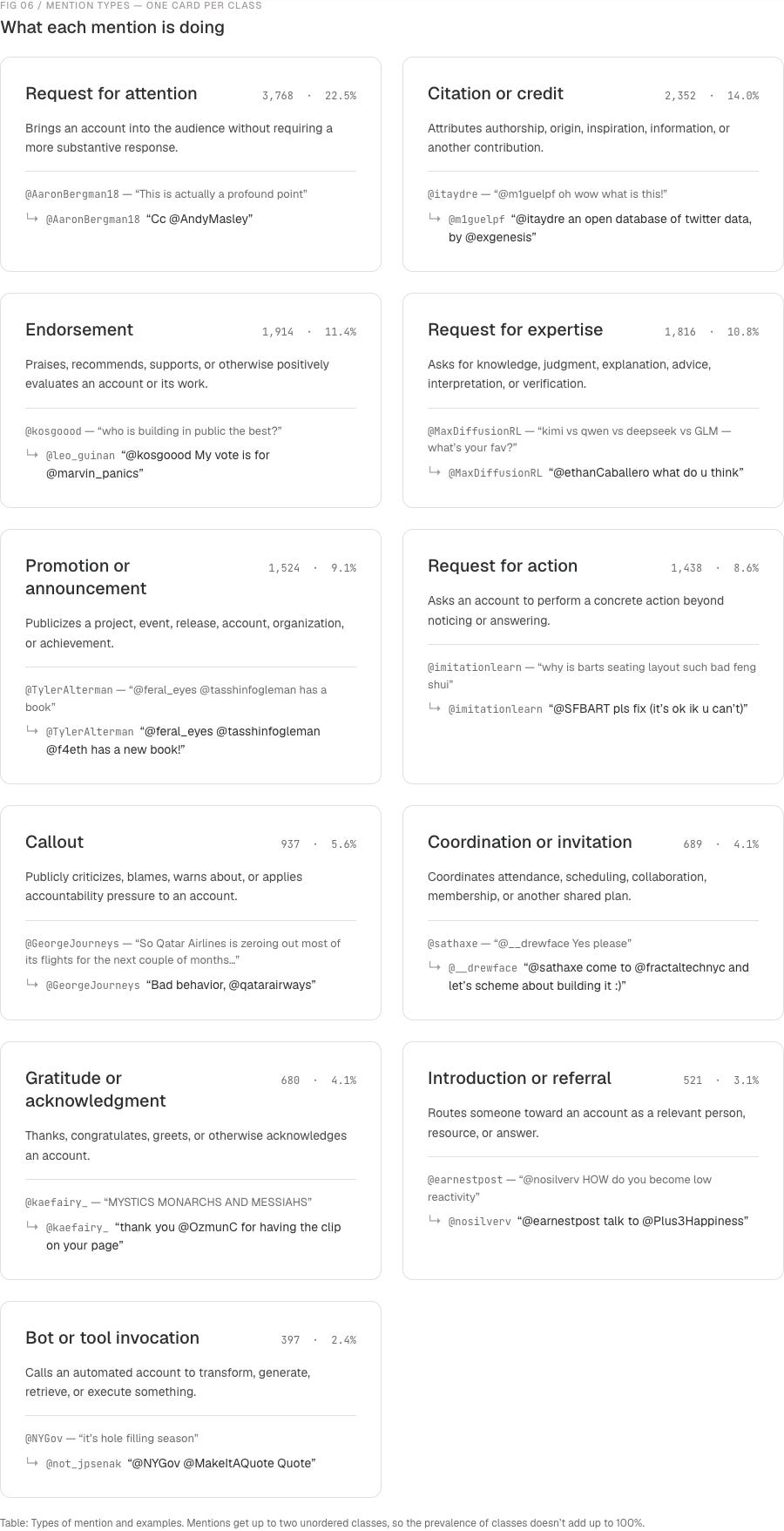
It was satisfying to see that the 4 most common types of mention map closely to what we had in mind before starting:
Requesting attention on a post
Citations
Requesting expertise
Endorsements
Now that we’re acquainted with the data, let’s look at how agents perform at the task.
Example task walkthrough
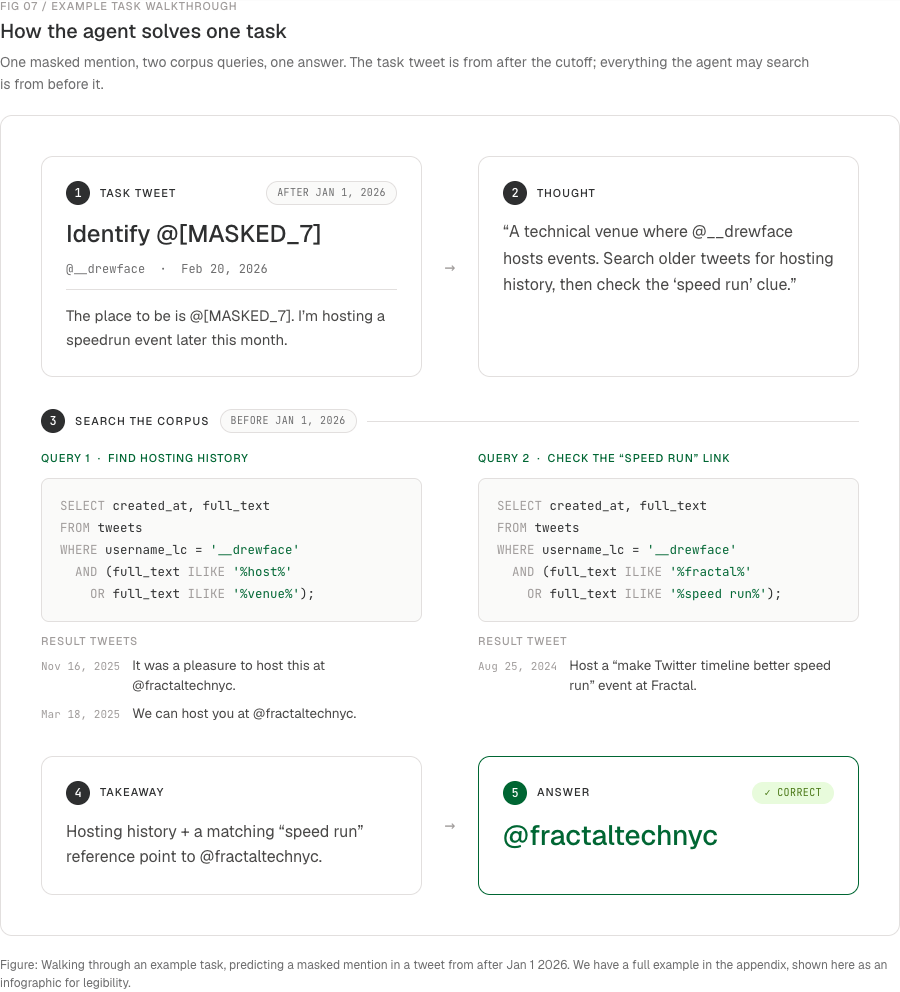
Tasks usually start from the agent seeing a set of tweets, in context, with masked handles. The agent then searches over historical data to find evidence of who the user may be mentioning, reasons about it, and produces an answer.
Model performance
Across 80 items covering @repligate, @richdecibels, @strangestloop, @thezvi, @visakanv, @qiaochuyuan, @nosilverv, and @tyleralterman, our human baseline scored 0.231 mean reciprocal-rank, with 18 top-1 and 19 top-3 matches.
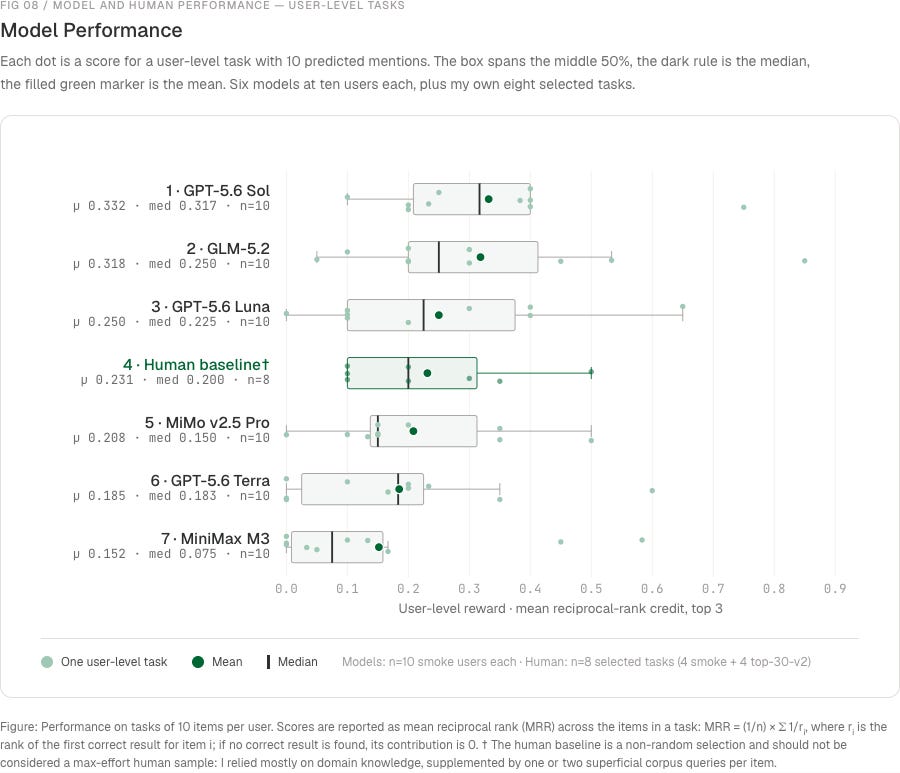
For our human baseline, we did not choose target users randomly. We favored people and domains where we felt we had some existing knowledge. This should not be considered a maximum effort human sample, as we relied mostly on domain knowledge, supplemented by relatively superficial corpus searches - typically one or two queries per item like “who does the user talk to the most?” or search over a salient keyword.
We are missing some baseline heuristics. E.g., one baseline could be analogous to the “popularity” baseline in recommender systems: simply predict the account most frequently mentioned by the focal user. Another could be something like “popularity-plus”: take the top 10 most frequently mentioned accounts by the focal user and have the agent quickly decide which is most likely via superficial/cursory search, e.g. the name/description of the account and their most recent 5 tweets.
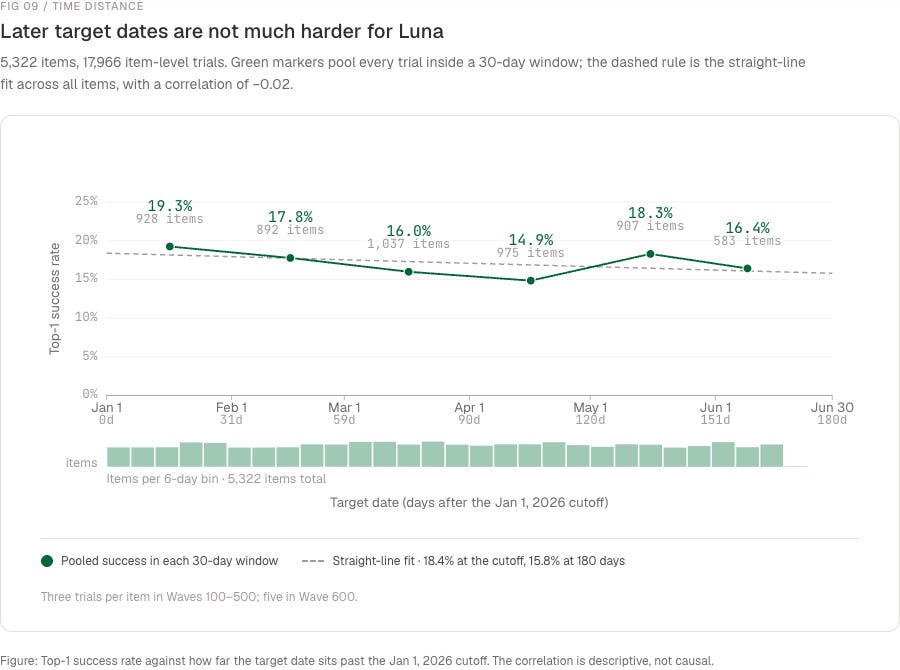
Does time distance from cutoff correlate with performance?
Since we chose a fixed time cutoff, we wondered if later mentions are harder to predict. We did find a subtle correlation between distance from the cutoff and difficulty.
Trajectory analysis
Strategy taxonomy
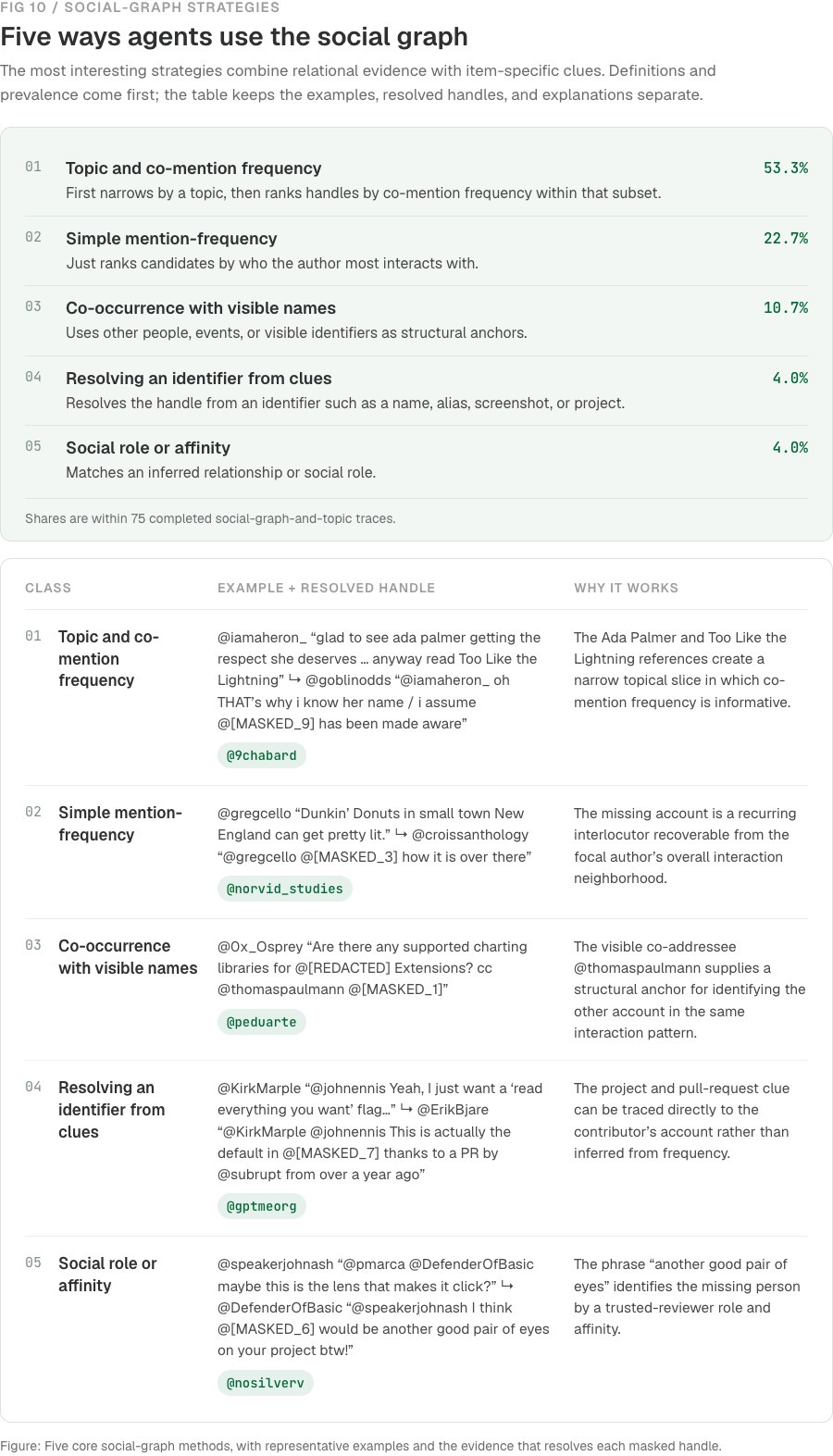
How do agents solve the task? We identified 5 classes of strategy by summarizing the paths agents took over 300 items and asking GPT 5.6 Sol to cluster them into a few types.
How agents fail
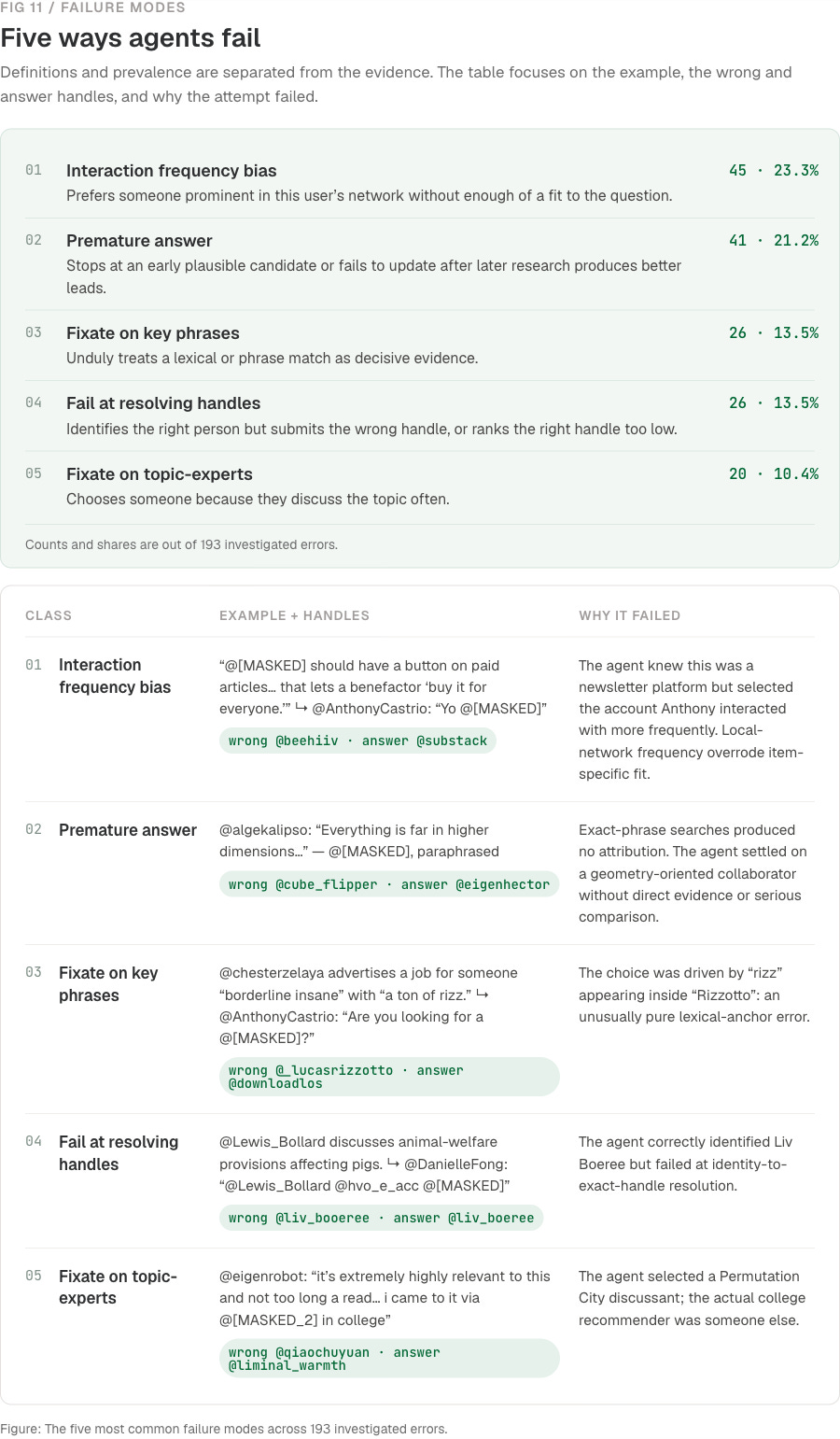
Common ways agents fail at this task include over-indexing on familiar accounts, terminating a search too early, and anchoring too much on a keyword.
A hard set
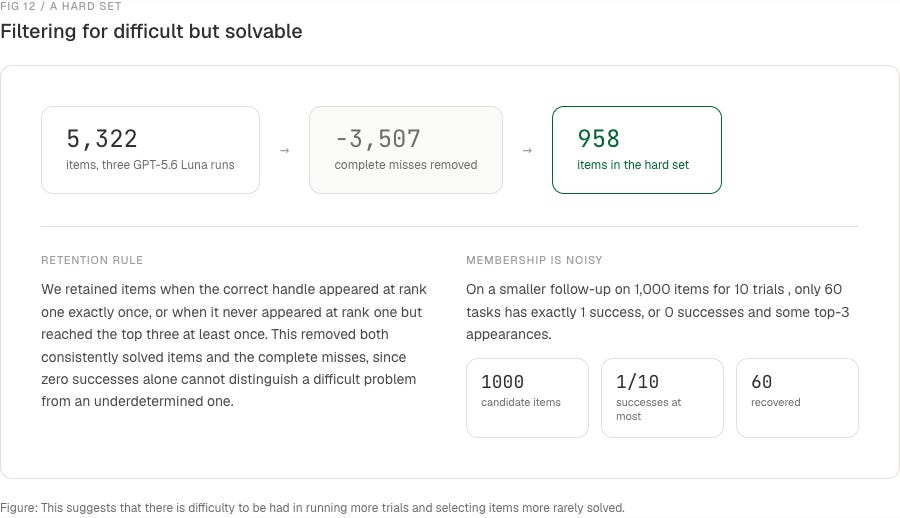
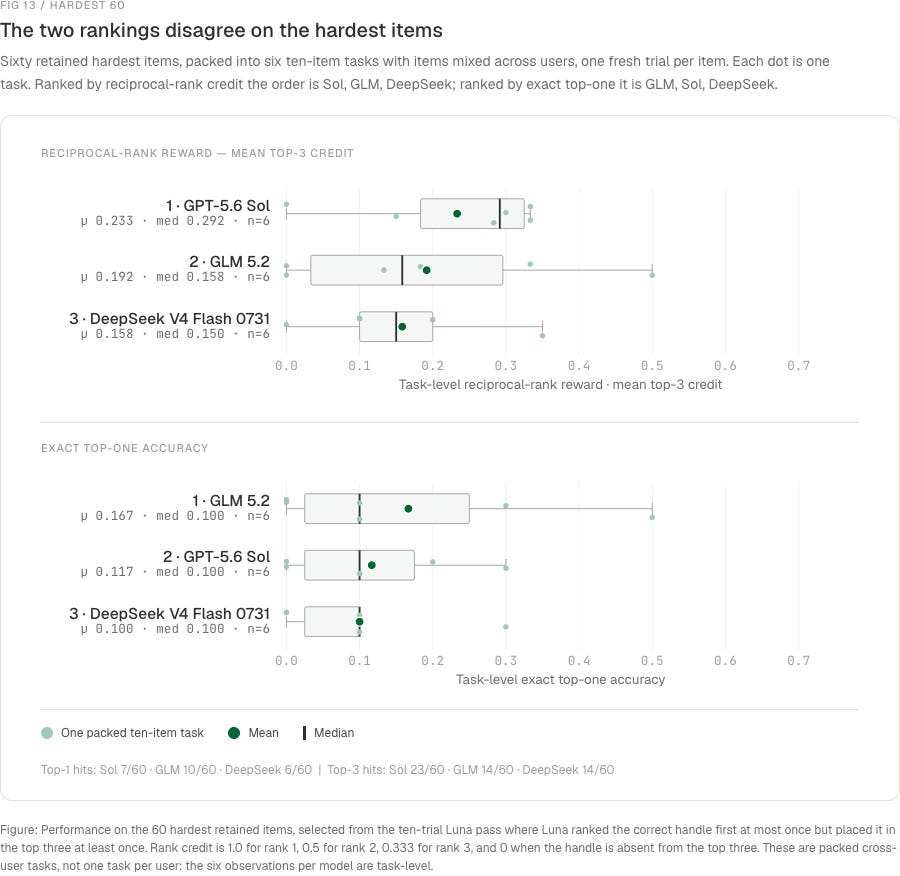
I ran GPT 5.6 Luna Pro on 5,322 tasks three times each and selected the 958 tasks with exactly 1 success out of 3 attempts. We also selected an even smaller set of 60 tasks out of 1,000 with exactly 1 success out of 10 attempts (or 0 successes in top-1 but some in top-3).
Conclusion
The Switchboard Operator benchmark evaluates the skills of a “switchboard operator” (or super-connector) such as content recommendations, making relevant introductions, and eliciting expertise in large networks of users. It measures whether an agent can reconstruct a local map of who knows whom and who knows what from evidence available before the task.
We believe that typed networks of mentions - like endorsements or gratitude or expertise requests - are a useful tool to study networks of groups of humans, swarms of agents, and hybrid systems.
On our initial panel, the strongest model reached 0.332 mean reciprocal rank. Looking for hard tasks, we found 60 items in 1,000 that agents succeeded at only once in 10 trials. This gives us some confidence that many items in the benchmark are difficult but possible, indicating a strong candidate for evaluating capable models and harness interventions.
We learned about how agents solve the task of predicting future mentions. One common success strategy was to intersect a topical clue with the user’s social graph. A common failure mode was to bias towards familiar users despite a poor fit.
As future work, we’re excited to see the fruits of post-training on the task, as we expect models to be super-human at creating serendipity via elicitation, recommendations, and introductions.
Thanks to Alexandre Variengien for help ideating the research concept, Christine Shiba for design and copy help, Deklan Webster for comments and review, and to Variance for supporting and funding this research.